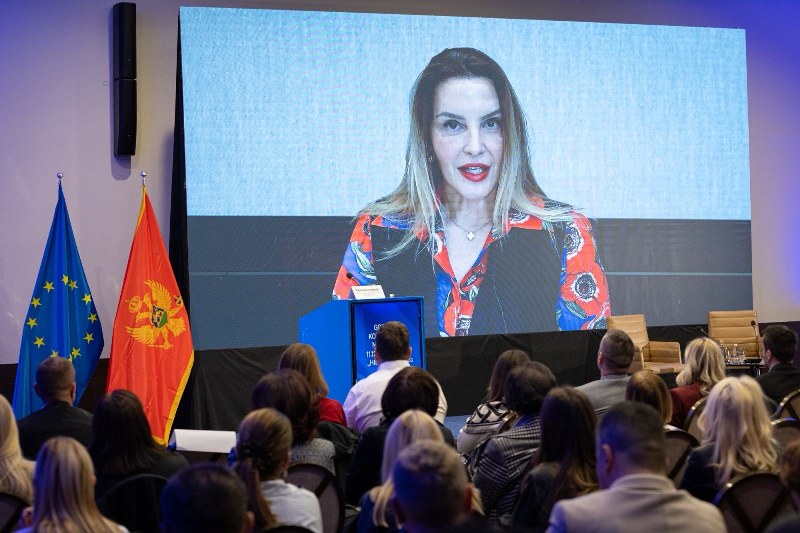
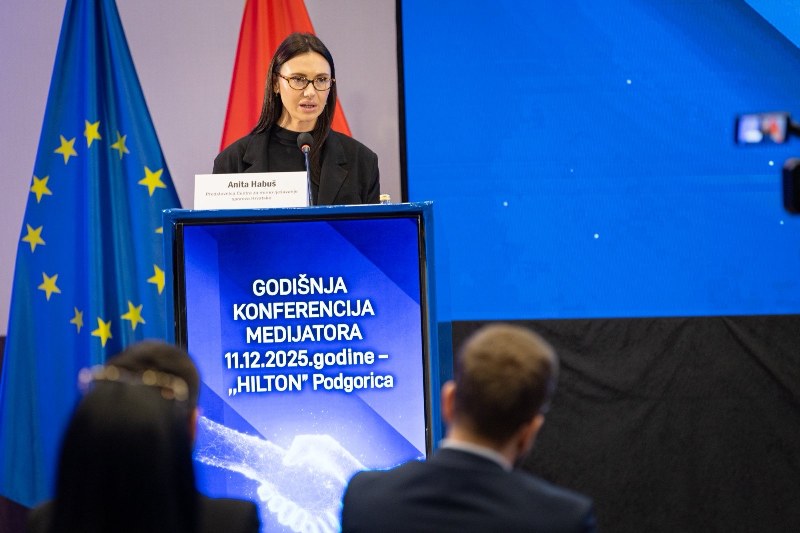
The Centre for Alternative Dispute Resolution organized today, at the Hilton Hotel in Podgorica, the Annual Conference of Mediators, dedicated to strengthening the culture of dialogue and promoting mediation as a modern and efficient mechanism for dispute resolution. The conference brought together representatives of the judiciary, the business sector, the academic community, international organizations and professionals in the field of mediation.
The message from the Conference was that mediation is one of the most noble and efficient ways of resolving disputes, through a process based on trust, understanding and the willingness of the parties to jointly find sustainable solutions.
Reform Messages from the Ministry of Justice
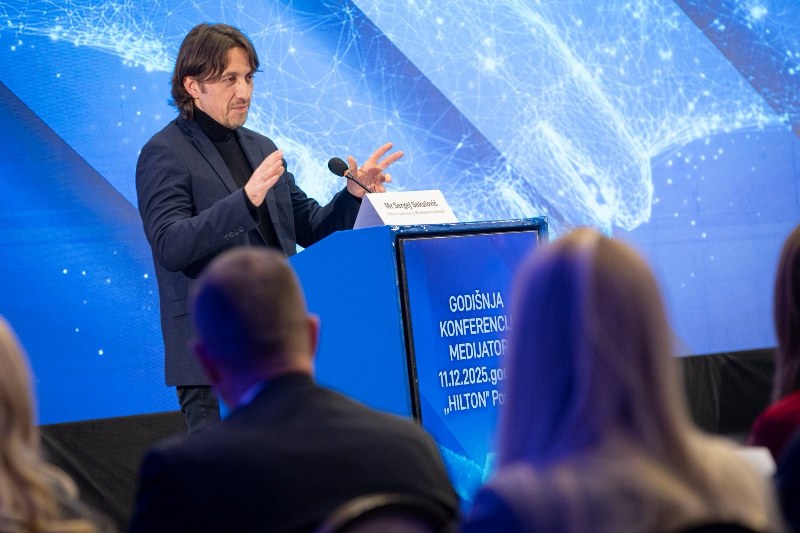
The State Secretary at the Ministry of Justice, Sergej Sekulović, stated that the development of mediation is one of the strategic priorities of the Ministry. He recalled that, during 2025, the Law on Alternative Dispute Resolution was amended and improved, creating better conditions for a more accessible, efficient and predictable procedure.
“It is encouraging that an increasing number of citizens, business people and institutions recognize mediation as a faster, more efficient and more accessible alternative to court proceedings. The two-year Programme for the Development of Alternative Dispute Resolution 2023–2025 has also been implemented, and the Final Report on the implementation of this Programme provides key recommendations that should serve as guidance for the further improvement of mediation procedures. In the coming period, it is necessary to analyse the needs and possibilities for introducing mediation in certain administrative areas, such as disputes between citizens and the administration, to consider preparing manuals that would facilitate the use of this institute, and to work on more intensive training and professional development of mediators, but not only of mediators — also on the education of holders of judicial offices, who are a key partner in this process.”
Sekulović emphasized that mediation is not merely an alternative to court proceedings, but also a cultural change in the approach to resolving conflicts — a change that leads to greater public trust in the legal system and reduces the workload of courts.
“Our goal is not only to have a stable legal framework, but to ensure the real, broad and everyday use of mediation as an active instrument of justice. We want a society in which conflicts are resolved reasonably and constructively, and in which the legal system is based on efficiency, trust and cooperation. Mediation is not merely a form of procedure. It is a cultural and social change in the way of thinking, a call for dialogue instead of conflict, and for cooperation instead of confrontation. The Ministry of Justice remains firmly committed to supporting and further strengthening this change.”
Sekulović particularly emphasized that the Ministry of Justice gives its full support to the Centre for Alternative Dispute Resolution, whose role is crucial in organizing procedures, professionalizing mediators, improving the quality of services and further affirming mediation as a reliable and efficient mechanism for dispute resolution.
Messages from the Centre for Alternative Dispute Resolution: Dialogue as the strength of justice
The Executive Director of the Centre for Alternative Dispute Resolution, Ms Maja Golović Vojinović, emphasized that, year after year, mediation is gaining an increasingly firm place in Montenegro’s legal culture. This is confirmed by the strong growth of trust among citizens and the business sector in this institute, reflected in the continuous increase in the number of cases, with around 15,000 mediation proposals submitted over the past two years.
“The core of every legal order is the need for efficient, fair and sustainable protection of rights. However, modern legal systems, including ours, face the challenges of overload, lengthy proceedings and rising costs. Therefore, through mediation, disputes are resolved in a faster, more humane and more constructive manner.”
She stated that the Centre is committed to promoting this institute in various areas, as well as to continuously improving the quality of services through the development of training programmes and strengthening the capacities of mediators.
“The Centre has conducted advanced training programmes for mediators, which will continue in the coming period with the aim of improving their knowledge and skills. As I have emphasized on several occasions, the work of the Centre rests on mediators and on their efforts to ensure that today’s Centre is recognized, both by the professional and general public, as an institution before which disputes are resolved through mediation in accordance with the law and the highest professional standards.”
The Director of the Centre also emphasized that the previous period was marked by intensive promotion of commercial mediation, strengthening of international cooperation, including the Memorandum with the AIRE Centre, partnership with GIZ and the signing of the Memorandum with the Ministry of Economic Development, as well as cooperation with the Ministry of Justice in the field of digitalization of the Centre and its connection to a single information system with judicial authorities.
Golović Vojinović emphasized that mediation is becoming an increasingly strong pillar of modern justice, while the Centre is the main institutional champion of its development.
“Our goal is a legal system in which we further develop mediation as a strong instrument of modern justice and jointly build a system in which dialogue and agreement are valued equally with a court judgment,” concluded Golović Vojinović.
International Cooperation – Key to the further development of mediation in Montenegro
A strong message from international partners confirmed that Montenegro holds an important place on the regional and European map of alternative dispute resolution.
Biljana Braithwaite, Programme Director of the AIRE Centre for the Western Balkans, greeted the participants of the Annual Conference of Mediators and expressed her wish for the Centre for Alternative Dispute Resolution to continue developing in an international direction. She stated that cooperation between CARS and the AIRE Centre would be further strengthened and that, in accordance with the signed Memorandum of Cooperation, joint activities would be carried out with the aim of improving mediation and alternative dispute resolution methods in Montenegro.
Anita Habuš, representative of the Centre for Peaceful Dispute Resolution of the Republic of Croatia, emphasized the value of regional cooperation and announced the implementation of joint training programmes for Montenegrin and Croatian mediators, aimed at improving professional standards.
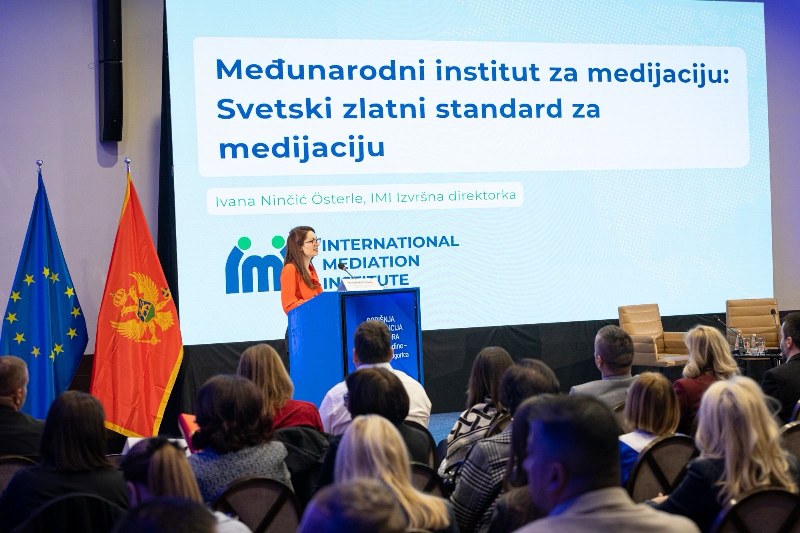
Ivana Ninčić Osterle, Executive Director of the International Mediation Centre, praised the efforts made by the Centre for Alternative Dispute Resolution in promoting and affirming mediation, emphasizing that international support and cooperation are an important foundation for the development of this institute in Montenegro.
Common Vision
The Annual Conference of Mediators concluded with the message that the success of mediation is based on teamwork among institutions, professionals and international partners. It was emphasized that mediation, as part of a common vision of modern justice, remains one of the key instruments for strengthening a culture of dialogue, trust and constructive dispute resolution.